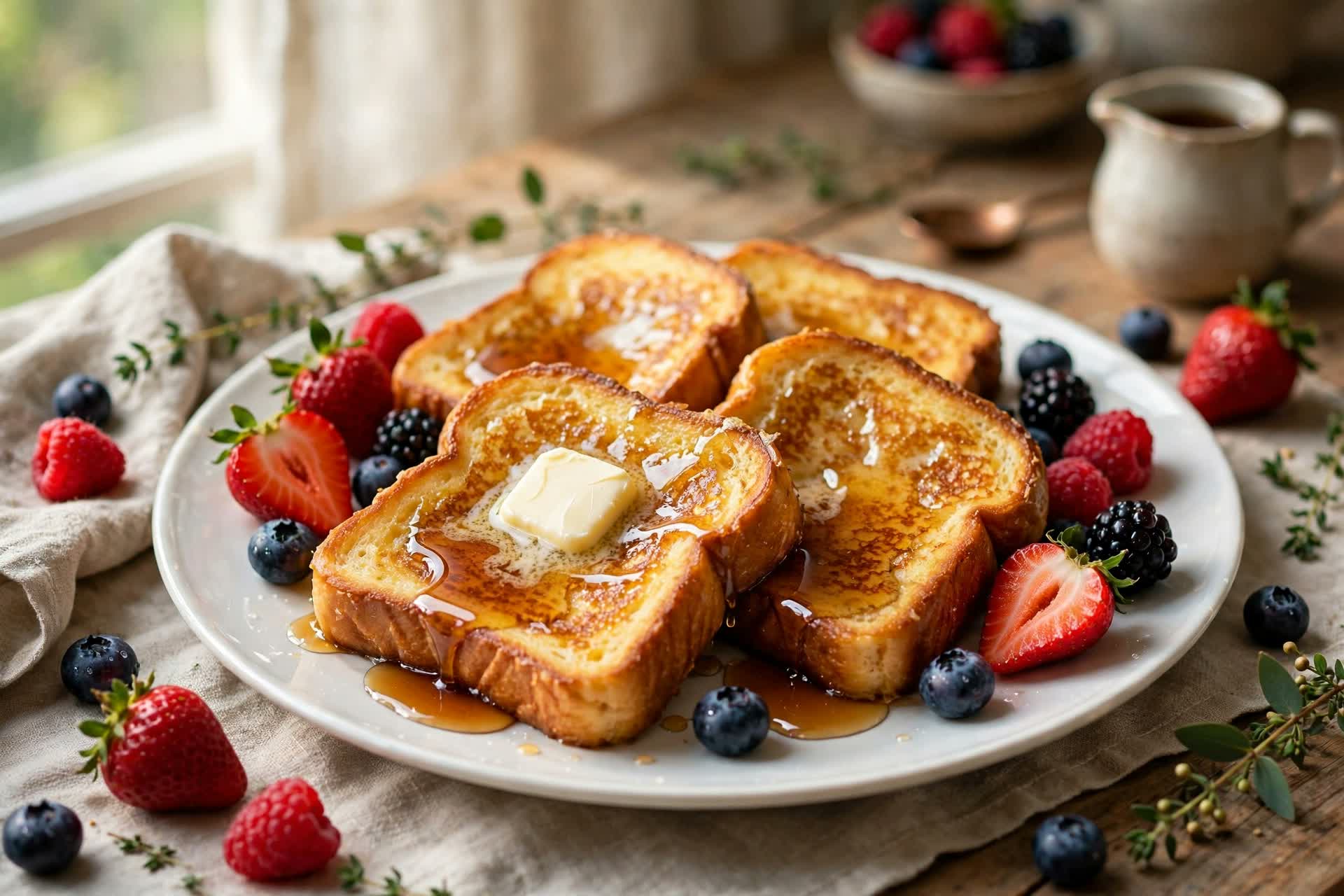
There is something about a Saturday morning that just calls for French toast. The house is still quiet, the coffee is brewing, and within a few minutes the whole kitchen smells like cinnamon and vanilla and warm butter. It is one of those breakfasts that feels like a treat but asks almost nothing of you — a handful of pantry staples, a hot skillet, and a loaf of bread that is honestly better a day or two past its prime.
I have been making French toast since I was tall enough to reach the stove, and I have learned that the difference between good French toast and great French toast comes down to a few small things: the right bread, a custard that is rich but not too eggy, and a pan that is hot enough to crisp the outside without burning it. Get those right and you end up with slices that are golden and slightly crunchy at the edges, soft and almost creamy in the middle, and ready for a generous pour of warm maple syrup.
This is the version I come back to again and again. It does not need any fancy equipment or hard-to-find ingredients, and it works just as well for a lazy breakfast for two as it does for a full table on a holiday morning. Once you have the base recipe down, you can dress it up a hundred different ways, but honestly, the classic version with butter, syrup, and a dusting of powdered sugar is hard to beat.
Why You’ll Love This Recipe
First, it is genuinely easy. If you can whisk eggs and flip a pancake, you can make French toast. There is no dough to rise, no batter to rest for hours, and no special pan required. A regular skillet or griddle does the job beautifully, and the whole thing comes together in about twenty minutes from start to finish.
Second, it is wonderfully forgiving. Slightly stale bread actually works better than fresh, so this is the perfect recipe for that loaf sitting on your counter. Thick slices hold up best, but even regular sandwich bread turns out just fine if you keep the soak short. And if you are cooking for a crowd, you can keep finished slices warm in a low oven while you work through the batch.
Third, everyone likes it. Kids love it with syrup and berries, adults love it with a little extra cinnamon or a dollop of whipped cream, and it is one of those rare breakfasts that pleases picky eaters and adventurous ones alike. It also scales easily — double the custard, slice another loaf, and suddenly you are feeding a houseful without any extra stress.
And finally, it is endlessly adaptable. The classic version is a perfect starting point, but you can swap in different breads, add orange zest or nutmeg to the custard, or top it with anything from sautéed apples to crispy bacon. It is a recipe that grows with you, and that is why it has stayed in my regular rotation for years.
Ingredients
- 8 slices day-old brioche, challah, or thick-sliced white bread (about 3/4 inch thick)
- 4 large eggs
- 1 cup whole milk
- 1 tablespoon granulated sugar
- 1 teaspoon vanilla extract
- 1/2 teaspoon ground cinnamon
- 1/4 teaspoon salt
- 2 tablespoons butter, plus more as needed for the pan
- Warm maple syrup, for serving
- Powdered sugar and fresh berries, for serving (optional)
Method
- Set out a shallow dish wide enough to fit a slice of bread lying flat — a pie plate or a small baking dish works perfectly. Crack the eggs into the dish and whisk them well until the yolks and whites are completely combined and there are no streaks left.
- Add the milk, sugar, vanilla, cinnamon, and salt to the eggs. Whisk again until everything is evenly mixed and the sugar has mostly dissolved. The custard should look smooth and smell faintly sweet and warmly spiced.
- Place a large skillet or griddle over medium heat and let it warm up for a couple of minutes. Add about a tablespoon of butter and let it melt and foam, swirling it to coat the pan. The pan is ready when the butter just starts to smell nutty — not brown, just fragrant.
- Working one slice at a time, lay a piece of bread in the custard and let it soak for about 20 to 30 seconds per side. Thick, sturdy bread can handle a little longer; thinner sandwich bread needs a quicker dip so it does not fall apart. Let any excess custard drip off before it goes in the pan.
- Place the soaked slices in the hot skillet, leaving a little space between them so they crisp rather than steam. Cook for 2 to 3 minutes on the first side, until the underside is a deep golden brown. Peek underneath with a spatula if you are unsure — you want a rich color, not pale blonde and not dark brown.
- Flip each slice carefully and cook for another 2 to 3 minutes on the second side, until golden and slightly puffed. If the pan starts to look dry, add another small pat of butter between batches.
- As each batch finishes, transfer the slices to a baking sheet and keep them warm in a 200°F oven while you cook the rest. This keeps everything hot and lets the centers finish setting without overcooking the outsides.
- Repeat with the remaining bread and custard, adding butter to the pan as needed. If the custard starts to get low, give it a quick whisk — the cinnamon has a habit of settling at the bottom.
- Stack the warm slices on plates and dust lightly with powdered sugar if you like. Add a handful of fresh berries for color and a little tartness to balance the sweetness.
- Serve right away with warm maple syrup poured over the top. French toast is at its best in the first few minutes off the pan, when the edges are still crisp and the middle is soft and custardy.
Tips and Variations
Bread choice matters more than anything else in this recipe. Brioche and challah are my favorites because they are rich and sturdy, and they soak up the custard without collapsing. A good thick-sliced white bread works too. Whatever you use, day-old bread is better than fresh — it is drier, so it absorbs the custard evenly instead of turning to mush. If your bread is very fresh, you can dry the slices out a bit by leaving them on a rack for an hour or popping them in a 300°F oven for a few minutes.
Watch your heat. Medium heat is the sweet spot. Too hot and the outside browns before the custard in the middle has a chance to set, leaving you with slices that look done but taste eggy inside. Too cool and the bread just sits there soaking up butter without ever crisping. If your first slice browns too fast, turn the heat down a notch and give the pan a minute to settle before continuing.
For a richer version, swap half the milk for heavy cream, or add a tablespoon of orange juice and a little orange zest to the custard for a bright, citrusy twist. A pinch of nutmeg alongside the cinnamon adds warmth, and a splash of bourbon or rum in the custard — just a tablespoon — gives the grown-up version a lovely depth. For a stuffed variation, spread softened cream cheese and a spoonful of jam between two slices before dipping, then cook a little longer over slightly lower heat so the filling warms through.
Leftovers are a gift, not a problem. Cooked French toast keeps well in the fridge for two or three days and reheats beautifully in a toaster or a hot, dry skillet. It also freezes well: lay the cooled slices in a single layer on a baking sheet, freeze until firm, then stack them in a freezer bag with parchment between the slices. They go straight from the freezer into the toaster on busy mornings, and honestly, that is one of the best breakfast shortcuts I know.
Frequently Asked Questions
What is the best bread for French toast?
Brioche and challah are the top picks because they are rich, slightly sweet, and sturdy enough to hold the custard. Thick-sliced white bread, Texas toast, and even a good sourdough all work well too. The main thing is thickness — slices around 3/4 inch give you that crisp outside and custardy middle. Very thin sandwich bread can work in a pinch, but keep the soak short so it does not fall apart.
Why is my French toast soggy in the middle?
Usually it comes down to one of three things: the bread soaked too long, the pan was not hot enough, or the slices were too thin. Let sturdy bread soak about 20 to 30 seconds per side, no longer. Make sure the pan is properly preheated so the outside sets quickly, and keep the heat at medium so the center has time to cook through without the outside burning.
Can I make French toast ahead of time?
Yes, and it is a great strategy for busy mornings or feeding guests. Cook the full batch, let the slices cool, and refrigerate them for up to three days. Reheat in a toaster, a 350°F oven for about 10 minutes, or a dry skillet over medium heat. For longer storage, freeze the cooled slices as described above — they keep for up to a month and reheat straight from frozen.
Can I make this dairy-free?
Absolutely. Swap the whole milk for oat milk, almond milk, or any plant-based milk you like, and cook the slices in a neutral oil or dairy-free butter instead of butter. Oat milk is my favorite substitute here because it is naturally a little thick and creamy, which keeps the custard rich. The rest of the recipe stays exactly the same.
What should I serve with French toast?
Warm maple syrup is the classic, but there are plenty of good options. Fresh berries, sliced bananas, and a dusting of powdered sugar are simple and always welcome. For something more special, try sautéed apples with a pinch of cinnamon, a spoonful of whipped cream, or a side of crispy bacon or sausage for a sweet-and-savory plate. A hot cup of coffee alongside is, in my opinion, non-negotiable.
That is really all there is to it: simple ingredients, a hot pan, and a few minutes of attention, and you have a breakfast that feels like a small celebration. Whether it is a quiet weekend morning or a house full of guests, classic French toast has a way of slowing everyone down and gathering them around the table — and that, more than anything, is why I keep making it.